In the last decade, many articles have been published in technical journals, the majority of which emphasized on the necessity of manipulating balancing valves in HVAC systems. Here, we will go through how automatic balancing valves work and what their variability are as well as two important considerations when choosing and working with automatic balancing valves. In hydronic system, pressure drops due to fluid friction across pipes and fittings. The pressure from encountered by water up to each load may vary depending upon their distance from the pump and the number of fittings. Water tends to flow through the path of least resistance, thus, the loads with lower pressure drop will receive higher flow rates. That is, the nearer a load is to the pump, the more flow rate it receives. Balancing valves are used to compensate for variations in the piping pressure losses so as to ensure design flow rate through each load. It was conventional to use reverse-return piping system in order to compensate the pumping losses. However, balancing valves will still be needed if pressure drops across the loads asymmetrically.
Static Balancing valves
These are basically similar to globe valves but with some defined flow vs pressure drop characteristics. The flow through each valve is calculated by measuring the pressure drop across the valve. The flow through the valve varies in direct proportion to the orifice-pass-area and system balancing is achieved by adding flow resistance, by reducing the orifice-pass-area, in circuits with lower pressure drops. It may sound very simple on paper but in a system with several connected loads, changing the setting of any single balancing valve affects the whole system and several iterations at each balancing valve may be necessary to achieve the desired result.
Dynamic Balancing Valves
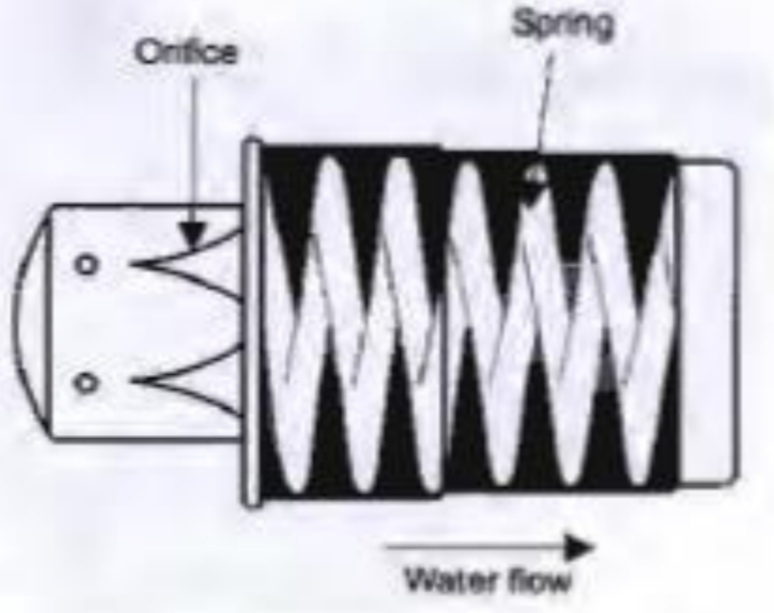
Dynamic balancing valves are basically developed to keep the flow of water constant under varying pressure conditions for water supply applications to prevent the scalding of one user under a shower when another user flushes a toilet. These valves work on the principle that the flow through an orifice varies according to the pressure across it, which may also be defined as that the flow through an orifice will remain constant if the size of the orifice is changed in proportion to the change in pressure drop across it.
The following figure shows a cartridge from this valve, in which the orifice has a variable opening and is spring loaded. Any change in pressure pushes or releases the spring to change orifice area, thus keeping the flow constant. The spring range is selected to match the pressure variations of the system. Normal system pressure should match the center of the spring range to ensure proper flow control, both in case of pressure increase or decrease. Outside the spring range, the valve acts as an ordinary valve with no control over flow.
Summary
Balancing valves are basically designed to keep the flow in a circuit constant. Static balancing valves are set to achieve this with the assumption that the pressure variations in the whole system are unlikely to be much. Automatic balancing valves maintain the constant flow even when there are pressure variations, within a certain range. These valves ensure better water distribution. If used in a constant flow system, ABVs are referred to as constant flow regulator (CFR). On the other hand, in a variable flow system, they are referred to as flow limting valve (FLV). If you are going to look for ABVs in manufacturers’ lists of products, be noted that for this purpose some brands provide PICVs without actuator, with a fixed preset and a protection. Some others, typically the brands that utilize the cartridge mechanism in their reugulating valves, provide inherently different product groups for PICV and ABV.